
Jump to a section
Choose a voice that fits the relationship
Tone is how your attitude and relationship appear through your words and grammar. A successful letter sounds appropriate from the greeting to the closing. It uses a voice that suits the person reading it: for example, a courteous professional request to an unknown manager or a warm message to a close friend. Formal writing need not be cold or complicated, and informal writing need not be careless. In either style, the reader should understand your purpose and the action you want them to take.
Use the whole situation to judge the relationship. An unnamed company representative usually calls for a formal style. A colleague you know, a course tutor or a neighbour may need a polite but more personal style. A close friend or family member usually permits contractions, direct personal references and warm expressions. These are guides, not three rigid boxes into which every relationship fits perfectly.
Vocabulary and grammar work together. “Would it be possible to…” softens a request to someone acting in a professional role. “Could you…” can work across several relationships. A direct command may be too abrupt when asking a manager for a favour, but natural when giving a friend simple directions. Always read it in context.
Practise one message in different relationships
Picture the actual reader rather than writing to an abstract “formal person”. A tutor who knows you needs enough identifying context, but not a life history. An unknown customer-service officer may need an order number and date. A close friend usually knows who you are already, so “My name is Alex and I am your friend” sounds unnatural. Your first sentence should begin the communication the relationship actually needs.
Example 1: ask for a change of time
To an unknown administrator: “Would it be possible to move my appointment to Thursday afternoon? I am unable to attend at the scheduled time because of a change to my working hours.”
To a colleague you know: “Could we move our meeting to Thursday afternoon? My shift has changed, so I will be unavailable on Wednesday.”
To a close friend: “Could we meet on Thursday instead? My shifts have changed and I can't make Wednesday.”
Why: All three communicate the same practical message. The formal version is more impersonal and avoids contraction; the friendly version is shorter and more conversational. None needs a rare word to be effective. Tone is not determined by sentence length or vocabulary difficulty.
Example 2: repair an abrupt formal request
Draft to a hotel manager: “Give me my money back and send it today.”
Revision: “I would therefore like to request a refund for the unused night. Please let me know how this can be arranged.”
Reasoning: The revision remains clear about the desired outcome but removes an aggressive command and an unexplained deadline. A formal complaint can be firm. Politeness does not mean hiding the problem or apologising for having a reasonable request.
Too elaborate: “I most humbly implore your distinguished establishment to exercise its benevolent discretion.” This obscures an ordinary request and sounds unnatural. Precision and a suitable relationship matter more than ceremonial language.
Example 3: keep the tone consistent
Mixed draft: “Dear Sir or Madam, I am writing to enquire about your weekend courses. Hey, your website is pretty cool! Tell me the cost. Lots of love, Alex.”
Consistent revision: “Dear Sir or Madam, I am writing to enquire about your weekend courses. I found the course descriptions helpful and would be grateful if you could send me details of the fees and start dates. Yours faithfully, Alex Morgan.”
Why: The greeting, body, request and ending now belong to the same professional relationship. A friendly remark is not forbidden in formal correspondence, but its wording must fit the recipient and purpose.
Use openings and endings for a reason
In the conventional British letter style commonly taught for IELTS, “Dear Sir or Madam” pairs with “Yours faithfully”. A named formal greeting such as “Dear Ms Reed” pairs with “Yours sincerely”. A known colleague may suit “Kind regards”, and a friend may suit “Best wishes”. Follow any opening instruction in the task rather than replacing it with a greeting you prefer.
Do not treat the greeting as the whole tone decision. “Yours faithfully” cannot make an otherwise aggressive or chatty letter formal. Equally, “Dear Sam” does not require slang in every line. Consistency depends on the vocabulary, requests, explanations and emotional language throughout the body.
A personal letter may use contractions such as “I'm”, “can't” and “we'll” naturally. A formal letter can usually avoid them without becoming stiff. Avoid messaging abbreviations such as “u” and “thx”; they are unnecessary in this written task. Express warmth through normal words and relevant detail.
Make politeness grammatically controlled
Compare “I would be grateful if you could…” with “I will grateful if you can…”. The first is a complete, conventional polite request; the second is missing “be”. Learn a useful phrase with its grammar, then adapt the content. Do not memorise an entire letter that may not fit the question.
Match the time too. “I was unable to attend” refers to a past event. “I will be unable to attend” refers to a future commitment. “I would like to attend” expresses a wish. In a letter requesting permission, these distinctions tell the recipient whether you are reporting what happened or asking for something yet to happen.
Construct tone through specific sentence choices
Formal means suitable for an official or professional relationship, often with someone you do not know. Informal means suitable for a close personal relationship. Semi-formal is a useful teaching label for polite correspondence with someone you know in a work or community role. These labels help you choose language; they are not separate scores. The whole letter must sound appropriate to the actual reader.
To build a request, start with the action you need: “Send the timetable.” That bare command may sound abrupt to an administrator. Put it inside a polite question: “Could you send me the timetable?” Add context if necessary: “Could you send me the new timetable so that I can choose a suitable class?” Now the request is clear and courteous. You have not hidden the action under rare words.
For a request that may inconvenience the reader, “Would it be possible to…” gives them room to consider it: “Would it be possible to move the appointment to Friday?” For a friend, “Could we move it to Friday? I can't get away from work on Thursday” is natural. Both are respectful, but their wording reflects different relationships.
Solved tone construction: the same delay, two relationships
Read the evidence
Facts: You cannot attend an event on Saturday because your train has been cancelled. You want to explain this and suggest Monday. Version one goes to a course tutor you do not know closely; version two goes to a good friend.
What must the response do?
Keep the facts identical while changing the voice. These are paragraph snippets, not complete letters.
Worked decision
To the tutor: “I am sorry that I will be unable to attend Saturday's session, as my train has been cancelled. Would it be possible to join the equivalent session on Monday instead?” To the friend: “I'm really sorry, but my train's been cancelled, so I can't come on Saturday. Could we meet on Monday instead?”
Why this works
The professional version avoids contractions and uses a more restrained apology. The personal version uses contractions and a conversational explanation. Neither adds an unrelated excuse. A formal version need not say “owing to unforeseen transportation-related circumstances”: the plain word “train” is precise.
Solved tone construction: a firm complaint without aggression
Read the evidence
Situation: A company promised delivery by Tuesday. The item has not arrived, and the writer needs it for an event on Friday.
What must the response do?
Compare “You people are hopeless. Deliver it now!” with a controlled request that remains firm.
Worked decision
Paragraph snippet: “The order was due to arrive on Tuesday, but I have not yet received it. I need the equipment for an event on Friday, so please confirm whether delivery can be completed by Thursday afternoon. If this is not possible, I would like to cancel the order and receive a refund.”
Why this works
The writer states the failure, explains the deadline and gives a practical alternative. Polite wording does not weaken the request: the desired action and fallback are explicit. Insults add no useful information and can make the tone unsuitable. “I would like to cancel” expresses the writer's choice; it does not claim the cancellation has already happened.
Do not make “informal” mean inaccurate
A friendly letter can contain complete, well-formed sentences. “Thanks for looking after my flat while I'm away” is informal and accurate. “Thx 4 flat care u amazing” is messaging shorthand and does not show the same control. Use everyday language, clear paragraphing and suitable contractions rather than deliberate grammatical mistakes.
Avoid treating idioms as compulsory. “I really enjoyed your visit” is a natural expression of appreciation. Adding an idiom whose meaning or form you do not control can make the letter confusing or exaggerated. Learn an expression with a realistic context and a complete sentence. If you would not naturally use it with this person, choose a clearer phrase.
Choose a closing that follows the relationship
After “Dear Sir or Madam”, the conventional British formal ending is “Yours faithfully”. With “Dear Ms Taylor”, “Yours sincerely” is suitable. For a known colleague, “Kind regards” may fit; for a friend, “Best wishes” is useful. “Lots of love” is appropriate only for a close personal relationship that supports it. Follow any opening supplied in the prompt rather than replacing it to force a different ending.
Then check the sentence before the ending. “I look forward to hearing from you” suits a formal request. “Let me know if you can make it” suits a friendly invitation. “Please reply immediately or else” introduces an aggressive ending even if the sign-off is formal. Tone is a continuous choice, not something created by one correct greeting.
Guided practice: Make this message suitable for an unknown admissions officer: “Hey, send me the dates. I'm dying to join. Cheers.”
Show the worked repair
“Dear Sir or Madam, I am interested in joining your evening course and would be grateful if you could confirm the next starting dates. Yours faithfully, Alex Morgan.” This is a short demonstration of tone, not a complete 150-word letter. It preserves the actual request and removes overly familiar wording. “Would be grateful” must include “be”; otherwise the polite phrase is grammatically incomplete.
Independent practice: A colleague you know has invited you to speak at a staff event, but you are unavailable. Write a polite refusal and offer an alternative without sounding like an unknown customer or a close family member.
Show a reasoned answer
“Dear Morgan, Thank you for inviting me to speak at the staff event. I'm afraid I won't be available that afternoon because I am attending training at the regional office. If it would help, I could record a short presentation beforehand or join the next event in person. Kind regards, Alex.” This is a paragraph-and-closing exercise. It acknowledges the invitation, explains the difficulty and offers something useful. A full task would require all its specific bullets and at least 150 words.
Try it yourself
You are writing to a neighbour whom you know by name but do not know closely. You need them to lower loud music late at night. Improve this message: “Hey! Your music is killing me. Stop it now. Yours faithfully.”
Show the explanation
“Dear Daniel, I wanted to ask whether you could keep the music a little lower after 10 p.m. The sound carries into my bedroom, and I have been finding it difficult to sleep before my early shifts. I would really appreciate your help. Kind regards, Alex.” This is polite and personal without being overly intimate. It identifies the problem and practical request rather than attacking the neighbour.
Before moving on: Read your next letter aloud as if the intended person were listening. Mark phrases that sound too distant, too casual or too aggressive, then revise them while preserving a clear purpose.
A visual worked example
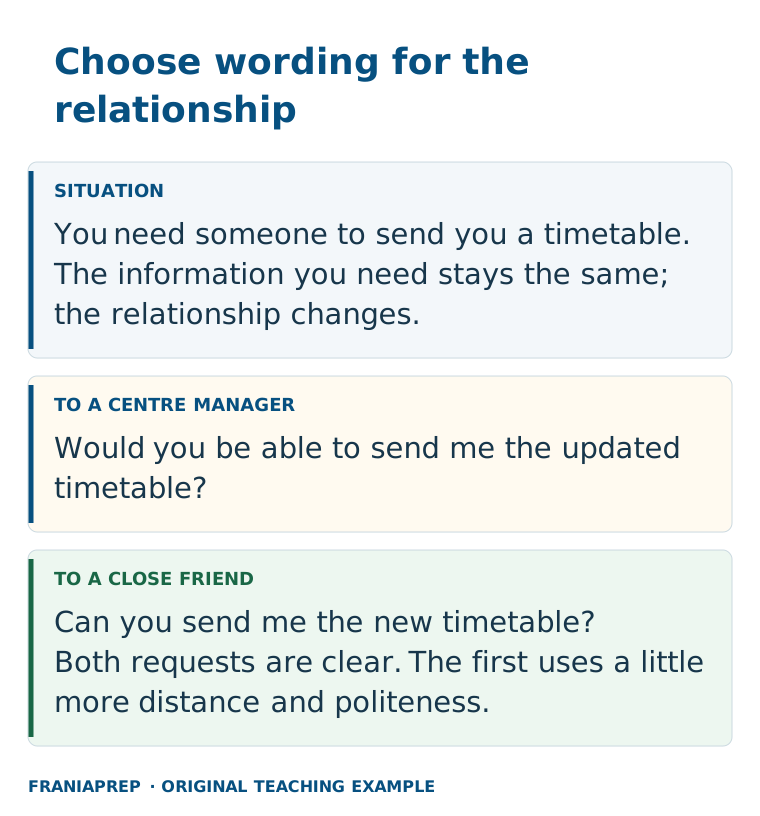
Begin with the person you are writing to. You may not know a centre manager personally, so a polite indirect request fits that relationship. With a close friend, the shorter question is natural and still courteous. Neither version needs difficult vocabulary. Keep the tone consistent in the greeting, explanation, request and ending. A friendly greeting followed by a threatening demand would send mixed signals, even if each sentence were grammatically correct.