
Jump to a section
Describe the direction, size and shape of a change
Changing data needs more than a collection of verbs for “rise” and “fall”. First decide what changed, over which period, and by how much. Then consider the shape: did the figure move in one direction, remain stable, peak, recover or fluctuate? Your language should follow the observations, not make a modest movement sound dramatic.
Distinguish the beginning and end from the path between them. A figure can finish where it started after several large movements. Another can rise overall despite a temporary decline. Report both the overall direction and any important exception. If only two observations are supplied, you can describe the difference between them, but you cannot claim that the figure rose steadily throughout the intervening years.
The subject must match the measure. “Sales rose” is suitable for sales data; “the proportion of journeys rose” is suitable for percentage shares. A number of people, an amount of money and a percentage require different nouns. Use “the figure” only when the reader can tell exactly which measurement it refers to.
Keep the units and the comparison separate
| Transport | 2005 | 2015 | 2025 |
|---|---|---|---|
| Car | 60 | 50 | 40 |
| Bus | 25 | 30 | 35 |
| Bicycle | 10 | 15 | 20 |
| Walking | 5 | 5 | 5 |
Build a data sentence from the figure, not from a vocabulary list
Take one clear observation: library loans go from 80,000 to 110,000 between 2010 and 2015. First name the measure: “Library loans”. Add the direction: “Library loans increased”. Add the start and finish: “Library loans increased from 80,000 to 110,000”. Add the time: “Library loans increased from 80,000 in 2010 to 110,000 in 2015.” You now have a complete factual sentence.
If the next observation reverses the movement, use a contrast or sequence: “They then fell to 100,000 in 2020.” Here “they” refers clearly to loans. To combine the ideas, write “After rising from 80,000 to 110,000, library loans fell to 100,000 in 2020.” The introductory phrase and the main subject both refer to the same measure. Do not attach “after rising” to an unrelated subject such as “the town”.
Only add a descriptive word if it improves precision. “Rose sharply” needs a sizeable change relative to the scale and period. “Rose gradually” concerns the shape across time, which requires enough observations to support it. A bar for 2010 and a bar for 2025 cannot show whether growth was gradual, sudden or interrupted in between. The safe choice is often the plain verb plus the exact figures.
Solved sentence construction: verb form and noun form
Read the evidence
Observation: Membership increases from 2,000 in 2020 to 2,400 in 2025.
What must the response do?
Express the same information using “increased” and then “an increase”. Explain the change in grammar.
Worked decision
Verb: “Membership increased by 400 between 2020 and 2025.” Noun: “There was an increase of 400 in membership between 2020 and 2025.”
Why this works
“Increased” performs the main action in the first sentence. In the second, “increase” is a noun after “an”, so it needs the surrounding structure “there was”. Use “an increase of 400” for the amount and “an increase in membership” for what changes. “There was an increased of 400” mixes the two structures.
Guided language practice: Correct “There was a sharply rise in the amount of visitors, which increased to 20,000 from 15,000 by 2025.” The figures describe different visitors counted at a centre, with 15,000 recorded in 2020.
Show the worked repair
“The number of visitors rose from 15,000 in 2020 to 20,000 in 2025.” This direct version avoids an unsupported modifier and uses “number” for countable visitors. If a noun phrase is useful, “There was an increase of 5,000 in visitor numbers” is also accurate. “Sharp” would modify a noun; “sharply” would modify a verb.
Example 1: from, to and by
Data: Bicycle journeys account for 10% in 2005 and 20% in 2025.
Accurate descriptions: “The share of bicycle journeys rose from 10% to 20%.” “Bicycle travel gained ten percentage points.” “The proportion doubled over the period.”
Why these differ: “From” gives the starting value; “to” gives the ending value; “by” gives the amount of change. From 10% to 20% is a ten-percentage-point increase and a 100% increase relative to the starting share. Calling it simply “an increase of 10%” risks confusing those two calculations.
Common mistake: “Bicycle travel increased by 20%.” That does not report a final share of 20%; it reports a relative increase. When in doubt, state the starting and ending percentages directly.
Example 2: an overall rise with a temporary fall
Data: A centre records 20,000 visits in 2010, 35,000 in 2015, 30,000 in 2020 and 45,000 in 2025.
Incomplete: “Visits increased steadily from 20,000 to 45,000.” The fall in 2020 contradicts “steadily”.
Better: “The number of visits rose overall from 20,000 to 45,000, despite a temporary decline from 35,000 to 30,000 between 2015 and 2020.”
Why it works: The sentence gives the main direction first, then qualifies it with the important interruption. The final value is the highest recorded, so you could also write “reached a peak of 45,000 in 2025”. Do not claim that it was an all-time record; the data cover only this period.
Example 3: choose the tense for the evidence
Chart: Past observations show 40,000 units in 2015 and 60,000 in 2025. A dotted line forecasts 80,000 in 2035.
Suitable: “Output increased from 40,000 units in 2015 to 60,000 in 2025 and is projected to reach 80,000 by 2035.”
Why: The first movement is an observation, so it is reported as a past event. The second is a projection, so the language marks its status. “Output will certainly reach 80,000” claims a certainty that the forecast does not supply.
Alternative: “A further increase to 80,000 units is forecast for 2035.” This changes sentence structure without changing meaning or pretending the prediction is the writer's own.
Vary the grammar naturally
You can use a verb phrase, “bus use increased gradually”, or a noun phrase, “there was a gradual increase in bus use”. Notice the forms: an adjective describes the noun “increase”; an adverb describes the verb “increased”. Avoid “a gradually increase” and “increased gradual”. A useful range of structures comes from expressing different relationships accurately.
Use strong modifiers sparingly. “Slight” and “sharp” describe the scale or appearance of a change relative to its context. A rise from 100 to 102 is unlikely to justify “soared”. “Fluctuated” suggests repeated upward and downward movements, not simply a single fall followed by recovery. “Remained stable” allows little or no change; “remained exactly the same” requires identical values.
Compare related movements instead of writing one sentence per line. In the commuting table, “While the car share fell by 20 percentage points, bus and bicycle travel each gained ten” gives three changes in a meaningful relationship. It also avoids repeating “increased” and “decreased” mechanically.
One further language check: figures and agreement
“The number of visitors was 30,000” has the singular subject “number”. “Visitor numbers were higher” has the plural subject “numbers”. Both are useful, but mixing them produces an agreement error. Similarly, write “three million visits” for an exact quantity and “millions of visits” for an unspecified one. Avoid “three millions visits”. These small grammatical choices affect the precision and readability of the whole report. During checking, read the subject and verb together, temporarily ignoring intervening phrases. This makes it easier to notice disagreement that a long sentence can otherwise hide.
Read a second line chart: overall movement and interruption
Solved line-chart analysis: a rise is not necessarily steady
Read the evidence
| Year | Loans |
|---|---|
| 2010 | 80,000 |
| 2015 | 110,000 |
| 2020 | 100,000 |
| 2025 | 140,000 |
What must the response do?
Write a broad pattern, then support the temporary exception.
Worked decision
Overview snippet: “Loans increased overall and reached their highest recorded level in 2025, despite a temporary fall after 2015.” Detail snippet: “They rose from 80,000 to 110,000 before dropping by 10,000; the final value was 140,000.”
Why this works
The overall increase is 60,000, or 75% of the starting value. “Rose steadily” would hide the fall. “Fluctuated wildly throughout” exaggerates a series with only one recorded reversal. The points establish observations; the connecting segments do not prove what happened in each unrecorded year.
Solved time-series bar analysis: distinguish historic values and forecasts
Read the evidence
| Year | Status | Output |
|---|---|---|
| 2020 | Observed | 40,000 |
| 2025 | Observed | 60,000 |
| 2030 | Forecast | 90,000 |
What must the response do?
Use the correct time and certainty in one comparison.
Worked decision
Paragraph snippet: “Output rose from 40,000 units in 2020 to 60,000 in 2025. It is forecast to increase by a further 30,000 to 90,000 in 2030.”
Why this works
The final bar is projected, not an observed result or your own prediction. “Will definitely produce 90,000” overstates it. The first gain is 20,000; the forecast gain is 30,000. Both intervals are five years, so their absolute changes can be compared over the same duration.
Describe zero, negative values and proportions carefully
If a balance falls from 20 million to minus 5 million, it falls by 25 million and changes from a positive balance to a deficit. It does not fall “by 5 million” merely because minus 5 is the final value. If it then rises to zero, the deficit has been eliminated; a profit has not yet been established. Prefer these clear descriptions to a percentage change across zero, which can confuse the reader.
A change from 25% to 40% is an increase of 15 percentage points. It is a 60% relative increase because 15 ÷ 25 = 0.6. Forty per cent is two fifths; 25% is a quarter; 75% is three quarters. Use fractional wording where it is accurate, and “about a third” for 33% if that degree of approximation fits the source. Do not change an exact supplied value into a different one for variety.
Fresh practice: A fund's balance is minus 12 million in 2020, minus 4 million in 2025 and plus 3 million in a 2030 forecast. Describe its movement without giving an unsupported percentage change.
Show the worked explanation
“The deficit narrowed from 12 million to 4 million between 2020 and 2025, and the fund is projected to record a surplus of 3 million in 2030.” The historical balance improves by 8 million; the projected further improvement is 7 million. “The deficit rose to 3 million” would reverse the meaning of the final positive balance.
Try it yourself
Sales figures are 80,000 in 2010, 100,000 in 2015, 90,000 in 2020 and 120,000 in 2025. Correct this sentence: “Sales raised steadily by 120,000 from 2010 until 2025.” Then add the important exception.
Show the explanation
“Sales rose overall from 80,000 in 2010 to 120,000 in 2025, although they fell from 100,000 to 90,000 between 2015 and 2020.” Use “rose”, because sales themselves changed; “raised” normally needs an agent raising something. “To 120,000” gives the final figure; the increase was 40,000. “Steadily” is unsuitable because the series includes a decline.
Before moving on: Check one of your own descriptions for every “by” and “to”. Recalculate the change and confirm that each preposition expresses the number you intended.
A visual worked example
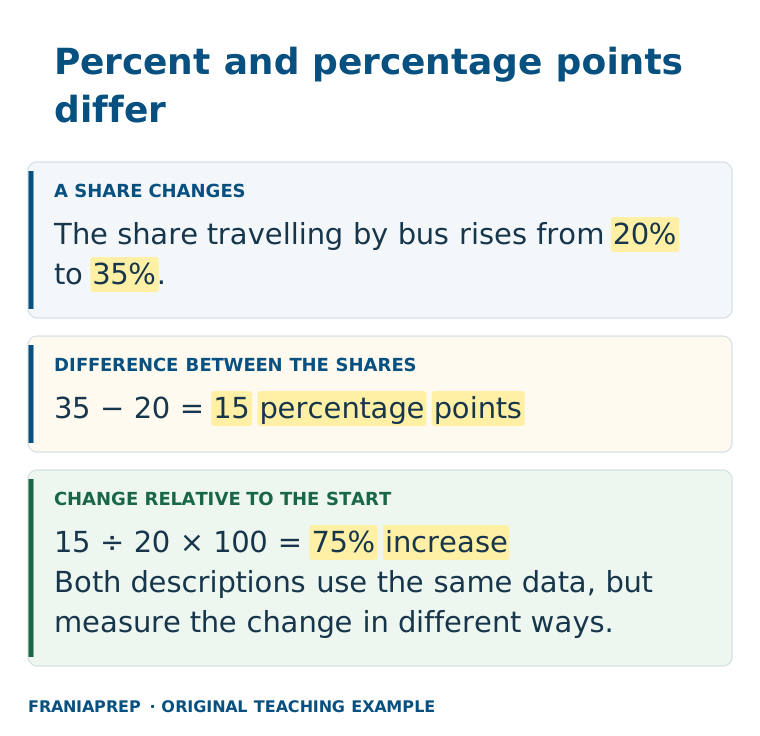
Imagine 100 commuters. At the first date, 20 of them use buses; at the second, 35 do. The difference is 15 out of the same 100, so the share rises by 15 percentage points. To calculate the relative increase, compare those 15 additional bus users with the original 20: 15 divided by 20 is 0.75, or 75%. You do not need to calculate a relative increase in every report. Use the clearest accurate comparison, and do not call a change from 20% to 35% a 15% relative increase.
Put this lesson into practice
Work at your own pace, then check your answers and review the explanations.