
Jump to a section
Say the paragraph’s main message in simple words
A heading is a short title for a paragraph or section. The main idea is what that whole section is mainly communicating. A supporting detail is a fact or example used to explain it. Imagine telling a friend the point of the section in one sentence. That sentence should cover more than its most striking word. This lesson shows how to compare your understanding with the offered headings, including situations where two options sound possible until you read the whole section.
A heading must represent the whole section
A heading summarises the main idea of a paragraph or labelled section. It should explain what the section is mainly doing, not merely repeat a word that appears in it. A paragraph about the failed launch of a new service may mention a train, an advertisement and a budget. A heading about transport is unsuitable if the real point is why the launch failed.
Read the list of headings to understand the distinctions between them, then survey the passage. For the section you are answering, read enough to identify its central message. A brief summary in your own words can help. Then compare that summary with the offered headings. If two seem plausible, ask which one explains more of the section and which one depends on a minor example or unsupported detail.
Use topic, scope and purpose to compare alternatives
The topic is the general subject, such as public libraries. Scope identifies which aspect is being discussed: their history, changing users or funding. Purpose describes what the writer does with it: explain a cause, challenge an assumption, compare approaches or describe a consequence. A good heading usually matches all three.
The first sentence often introduces the topic, but later sentences may narrow, qualify or reverse the initial impression. Read the section as a unit. In a labelled section containing several paragraphs, the heading must cover the section's central direction. Do not force a heading onto only the opening sentence or the most memorable example. Extra headings are included because some related ideas will not represent any section fully.
Solved example 1: the topic is broad, the purpose is specific
Paragraph A: “When the new evening bus route opened, planners expected shift workers to use it most. The largest group of passengers turned out to be college students returning from classes. Older residents also used it for social visits, particularly on Fridays. The pattern led the council to reconsider the timetable it had designed around factory finishing times.”
Headings: i The difficulty of employing bus drivers; ii Unexpected users reshape a transport plan; iii Why factories need later closing times.
Show the explanation
Answer: ii. The paragraph moves from an expectation about users to a different observed pattern and a revised plan. Shift workers and factories are background to that contrast. There is no discussion of recruiting drivers, so i introduces a different issue. Heading iii borrows the factory topic but changes the purpose: the council is reconsidering the bus timetable, not arguing that factories should close later. A useful summary is “actual users differed from expected users, so scheduling changed”.
Solved example 2: several examples support one shared idea
Paragraph B: “Public drinking fountains appeared in a number of towns during the nineteenth century. In some places local charities funded them; elsewhere merchants paid for fountains near busy markets. A few were installed by factory owners for employees. Although their sponsors differed, these projects all sought to make safe water available beyond private homes.”
Headings: i Different sponsors pursue a common public benefit; ii How merchants controlled water prices; iii The replacement of factories by markets.
Show the explanation
Answer: i. Charities, merchants and factory owners are examples of different sponsors. The closing sentence makes their shared purpose explicit: access to safe water. Heading ii focuses on only one sponsor and adds price control, which is not discussed. Heading iii uses two nouns from the passage but invents a replacement relationship. Headings can sound plausible because they contain familiar vocabulary; the complete idea must still be supported.
Solved example 3: an opening claim is challenged
Paragraph C: “Digital displays are sometimes described as a cheap replacement for printed notices. Yet the screen is only one part of the expense. Software licences, repairs and regular content updates all require money or staff time. Organisations comparing the two systems therefore need to consider the cost of running them, not just the purchase price.”
Headings: i A guaranteed saving for every organisation; ii Looking beyond the initial cost; iii Why notices are no longer read.
Show the explanation
Answer: ii. The main argument is that purchase price alone is insufficient. Running costs qualify the apparent saving. Heading i resembles the opening claim but ignores “yet” and the explanation that follows. Heading iii concerns readership, which is not evaluated. This is why reading only the first sentence can produce an attractive wrong answer. The paragraph's argument emerges through the contrast between initial appearance and fuller accounting.
Solved example 4: a local detail versus the whole section
Section D: “The project used a simple three-stage selection process. Applicants first submitted a short description, then discussed it with a tutor. Only after this conversation did they prepare a detailed budget.
“The conversation was particularly useful because it identified unrealistic plans early. Several applicants reduced their proposals before spending time on financial estimates. The organisers believe this order prevented unnecessary work.”
Headings: i An application process designed to avoid wasted effort; ii The exact cost of employing tutors; iii Three reasons why all proposals failed.
Show the explanation
Answer: i. The section explains the order of selection stages and why that order helps. Tutor conversations are one stage, not the whole subject, and their financial cost is never supplied. The number three counts stages, not reasons for failure. Heading iii also falsely claims that all proposals failed. Check numbers and absolute claims in headings rather than assuming that any matching number is useful evidence.
Try writing the main idea before selecting
Paragraph: “The first version of the walking guide listed every building in the district. Readers found it exhausting and often abandoned the route halfway through. The revised guide concentrates on six buildings that illustrate different periods. It contains less information, but users report a clearer understanding of how the district developed.”
Headings: i Reducing detail to improve understanding; ii A district with no historic buildings; iii Why walkers prefer longer routes.
Show the explanation
Answer: i. The paragraph contrasts an overloaded guide with a selective one that improves understanding. Six is an example of selection, not the main idea itself. Heading ii contradicts the presence of historic buildings. Heading iii reverses the problem: readers struggled with the original route rather than asking for a longer one. Your own brief heading might be “a more selective guide works better”. That meaning matches i.
Use errors to improve paragraph reading
If your chosen heading is too narrow, underline all the sentences it fails to explain. If it adds an unsupported claim, identify the added claim. If it captures only the opening, describe how the rest of the paragraph develops or changes the message. This is more useful than treating each wrong heading as an arbitrary exception.
Practise with short articles by writing one plain sentence for each paragraph's main point. Then identify which sentences are evidence, examples or explanations. The better you become at seeing those roles, the easier it becomes to select a heading that represents the whole section accurately.
Work through a complete passage with one heading bank
In a full task, several sections share the same list of headings. Read the whole list once to understand the differences, then survey the passage. Do not use one heading simply because its repeated word looks attractive. Make a short list of possible headings for the current section, read the section again and remove each option that describes only a detail or changes the main message. Some headings will remain unused.
Here is the thinking process to practise. First ask, “What changes or develops in this section?” Then say the answer in ordinary language. Finally compare that meaning with the headings. If the paragraph first names a problem and then explains a failed attempt to solve it, a heading about the problem alone may be too narrow.
A. The repair café began when volunteers noticed usable appliances being discarded because replacement seemed easier than repair. Its first meetings focused on simple faults that owners could not diagnose themselves. By providing a place to inspect an item before throwing it away, the group hoped to change that decision.
B. Organisers expected donated equipment to be their main difficulty. In fact, local businesses supplied enough tools within a month. The harder problem was finding volunteers who could attend regularly and explain repairs clearly to visitors. The café therefore introduced a rota and paired new helpers with experienced repairers.
C. Visitors now often remain beside the repairer rather than leave an item and return later. They learn what caused a fault and how to avoid it. The organisers regard this shared learning as an important result: even when a particular appliance cannot be saved, its owner may be better prepared to care for the next one.
Headings:
i Learning that matters beyond one repaired object
ii A shortage different from the one anticipated
iii Persuading people to buy newer appliances
iv An alternative to immediate disposal
v The growing cost of specialist tools
vi Why visitors should leave during repairs
Choose the best heading for A, B and C.
Show the decisions and the full thinking process
A iv; B ii; C i.
A: The problem is usable goods being discarded. The café offers inspection before disposal. Heading iv captures that purpose. Heading iii reverses it, since the organisers want people to consider repair before buying.
B: Two difficulties are compared: expected lack of tools and actual lack of reliable skilled volunteers. Heading ii captures the contrast. Tools are prominent in the paragraph, but v is wrong because enough were donated and growing cost is not the central problem. The final rota is a response to the actual shortage.
C: The main point is owners learning transferable care skills, even when a repair fails. Heading i covers both successful and unsuccessful repairs. Heading vi contradicts visitors remaining beside the repairer. Notice that the first sentence alone describes a practice; the later sentences explain why that practice matters.
Try a new shared-bank task without a model beside it
A. The first walking leaflet described thirty sites in equal detail. Trial users often stopped before reaching the halfway point because the information was exhausting. A revised version selects eight sites that show different stages of the town's growth.
B. The organisers had originally planned a mobile-only guide. Older residents pointed out that not everyone had a suitable phone, so a printed version remained available. Both versions now contain the same route and explanations.
C. Feedback is collected each season. When construction blocks a path, the route is changed immediately; suggestions for new historical information are reviewed more slowly. Keeping the guide dependable requires this continuing work after publication.
Headings: i Continuing responsibility for a useful resource; ii Less information, better selection; iii Removing printed material entirely; iv Access for different users; v The complete history of mobile phones.
Show the answers and reasoning
A ii; B iv; C i. A explains reducing overload through selection. B preserves two formats to prevent exclusion; iii reverses the actual decision. C focuses on updates and maintenance, not simply collecting opinions. The spare heading about phones contains a related object but is much broader than the passage. For every answer, point to both the section's problem and the way its later sentences develop that problem.
A visual worked example
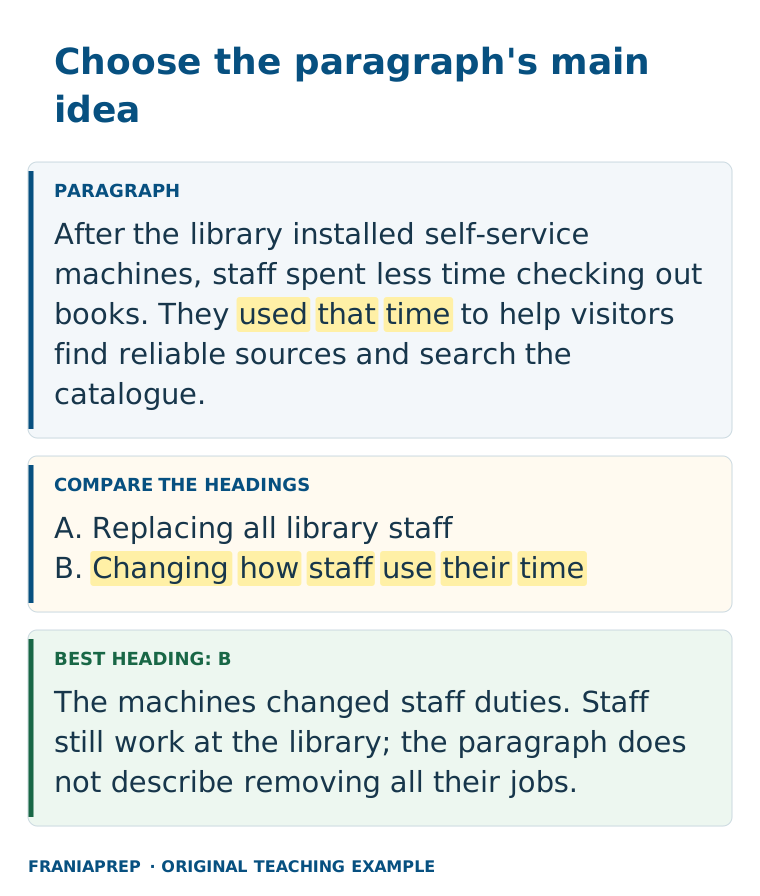
First ask what changed. The paragraph begins with machines, but it then explains how staff used the time those machines saved. That second sentence completes the main point. Heading A adds "all", and it also says the staff were replaced. Neither claim is supported. Heading B fits both sentences: time spent checking out books fell, and time spent helping visitors became available.
Put this lesson into practice
Work at your own pace, then check your answers and review the explanations.