
Jump to a section
Three answers, three different evidence decisions
You will read a passage and decide whether each statement agrees with it, contradicts it or cannot be settled from it. A statement is a claim expressed in a sentence. Contradicts means that the passage gives information that cannot agree with the claim. You do not need to know whether the statement is true in the outside world. Your job is narrower: decide what this passage establishes. We will practise that decision slowly, including cases where a familiar topic is mentioned but an important comparison or condition is missing.
Judge the statement against the passage
True, False and Not Given questions ask whether a statement is supported by the information you read. True means the passage supports the statement. False means the passage provides incompatible information, so the statement is incorrect. Not Given means the information does not settle the claim either way. Your knowledge of the world, or what seems likely, cannot fill a gap in the evidence.
False does not require a neat dictionary opposite. If the passage says a building opened in 1998 and the statement says 2001, the date is simply wrong. Equally, a statement can share nearly all its words with the passage and still be Not Given if it adds an unsupported reason, comparison or condition. Focus on the complete claim rather than counting familiar words.
Locate the topic, then check the exact relationship
Break the statement into its subject, action and important qualifications. Notice dates, quantities, comparisons and words such as “only”, “all”, “mainly” and “because”. Find the relevant part of the text, then read it carefully. Ask: does this establish the whole statement, contradict part of it, or leave a necessary detail unresolved?
Not Given does not mean “I could not find a matching word quickly”. You may find the exact topic and still lack evidence for the claim. A paragraph might describe a successful project without saying it was cheaper than every alternative. The project exists and succeeded; the comparison remains unsupported. Identify what is missing before choosing Not Given.
One passage, several different claims
Practice passage: “Harbour Community Centre opened its pottery workshop in 2019. The workshop originally ran only on Saturdays. Since January this year, it has also offered a Wednesday evening session. Each session has room for ten learners, and all materials are included in the booking fee. Participants must bring their own apron. The centre has not published attendance figures or announced whether it will add further sessions next year.”
Solved example 1: a supported paraphrase
Statement: Learners do not have to pay an additional charge for the materials.
Show the explanation
TRUE. The evidence is “all materials are included in the booking fee”. If materials are included, they do not require a separate payment on top of that fee. The statement changes the wording but preserves the relationship. It does not claim that attending the workshop is free; there is still a booking fee. Be careful to retain that distinction when explaining your answer.
Solved example 2: an earlier arrangement is no longer current
Statement: The pottery workshop is available only on Saturdays.
Show the explanation
FALSE. “Originally” locates the Saturday-only arrangement in the past. “Since January this year” introduces an additional Wednesday session. The statement uses the present tense and says only Saturdays, so the current Wednesday option contradicts it. You can correct the false statement: the workshop now runs on Saturdays and Wednesday evenings. Merely finding the words “only on Saturdays” is not enough; you must notice when that description applied.
Solved example 3: capacity is not attendance
Statement: Every workshop session is attended by ten learners.
Show the explanation
NOT GIVEN. “Room for ten learners” gives a maximum capacity. It does not say that all places are filled. The passage explicitly says attendance figures have not been published, so the actual number at each session remains unknown. False would require evidence that at least one session had fewer or more than ten attendees. True would require support for every session being full. Neither is established.
Solved example 4: an obligation contradicts permission to omit it
Statement: Learners can attend without bringing an apron.
Show the explanation
FALSE. Participants “must bring their own apron”. That requirement is incompatible with the claim that they can attend without one. Materials being included does not remove the separate apron rule. The two sentences concern different responsibilities. This example shows why you should read the neighbouring sentence: an answer based only on the general word “materials” could overlook a specific exception.
Solved example 5: absence of an announcement is not a negative decision
Statement: The centre has decided not to offer any additional sessions next year.
Show the explanation
NOT GIVEN. The passage says the centre has not announced whether it will add sessions. That leaves the decision unresolved in the text. No announcement does not mean a decision against expansion. Nor does the success of current sessions prove that expansion will happen. To answer True or False, you would need a clear statement about the future decision itself.
Fresh practice: identify the evidence before revealing
Passage: “The town's bicycle-hire scheme began with 80 bicycles in 2021. Another 20 were added in 2023. Residents and visitors pay the same daily rate. None of the scheme’s current bicycles is electric. The council says it plans to introduce electric bicycles, but has not selected a supplier.”
Statements: 1. The scheme had 100 bicycles after the 2023 addition. 2. Visitors pay more than residents. 3. The council will purchase electric bicycles from a local company. 4. Electric bicycles are already available through the scheme.
Show the answers and reasoning
1 TRUE: 80 plus another 20 establishes 100. 2 FALSE: the same daily rate directly contradicts a higher rate for visitors. 3 NOT GIVEN: no supplier has been chosen, so its location is not established. 4 FALSE: the passage says “None of the scheme’s current bicycles is electric.” That sentence directly contradicts the statement. The council’s plan is only for the future. Do not guess dates or companies that the text does not give.
Review by correcting or naming what is missing
For a False answer, write a corrected version supported by the passage. For a Not Given answer, state the missing piece: actual attendance, a comparison, a reason or a future decision. For a True answer, identify the equivalent meaning in the evidence. These small explanations reveal whether you understand the category or guessed correctly.
Use the same evidence discipline for Yes, No and Not Given questions, while following their instruction about the writer's views or claims. Do not automatically substitute one set of answer labels for the other. The question tells you which labels to enter.
Slow down the comparison: who, what, when and how much?
A statement is a whole claim. Before looking for evidence, explain it in ordinary words. Suppose it says, “Every visitor received a free ticket on opening day.” You need information about every visitor, a ticket, no payment and opening day. A passage saying some invited guests received tickets would not establish the same thing. Notice these parts because they define the claim; do not assume a word such as every automatically signals False.
Once you locate the topic, read until the references are clear. It may take several sentences to discover what this, they or the change refers to. Compare the complete idea only after you understand that chain. If the claim is unsupported, say which piece is missing. If contradicted, identify the source fact that makes it wrong.
The park first planted oak trees beside the main road. Most failed during the second dry summer. The replacement planting used smaller native trees, which required less water during establishment. These trees survived the following summer, although staff still watered them weekly. The council has not compared the total costs of the two planting schemes.
1. The replacement trees survived the summer after they were planted.
2. The replacement trees received no additional water.
3. The replacement scheme cost less overall than the oak scheme.
Show the decisions and the step-by-step reasoning
1 TRUE; 2 FALSE; 3 NOT GIVEN.
First establish the reference: these trees refers to the smaller native replacement trees, not the original oaks. Therefore survival supports 1. Then check the condition: less water is not no water. Weekly watering directly contradicts 2. Finally identify what is absent: no total-cost comparison is supplied, so lower water needs cannot establish 3. A cheaper running requirement does not by itself prove lower total costs. Each answer comes from a specific evidence decision, not from the subject being familiar.
Fresh qualification practice
Passage: “Every Saturday course includes materials. The two weekday courses require learners to buy their own. The centre offers a discount to members, but it has not announced whether students can receive a separate reduction.”
1. All courses include materials. 2. Materials are included in every Saturday course. 3. Students are eligible for an additional discount.
Show the explanation
1 FALSE: weekday courses provide a stated exception. 2 TRUE: the Saturday claim preserves the source's restriction. 3 NOT GIVEN: student eligibility remains unannounced. The word all is not inherently wrong: it is supported for Saturday courses and contradicted for the larger set of all courses. Let the evidence decide rather than using absolute words as a shortcut.
A visual worked example
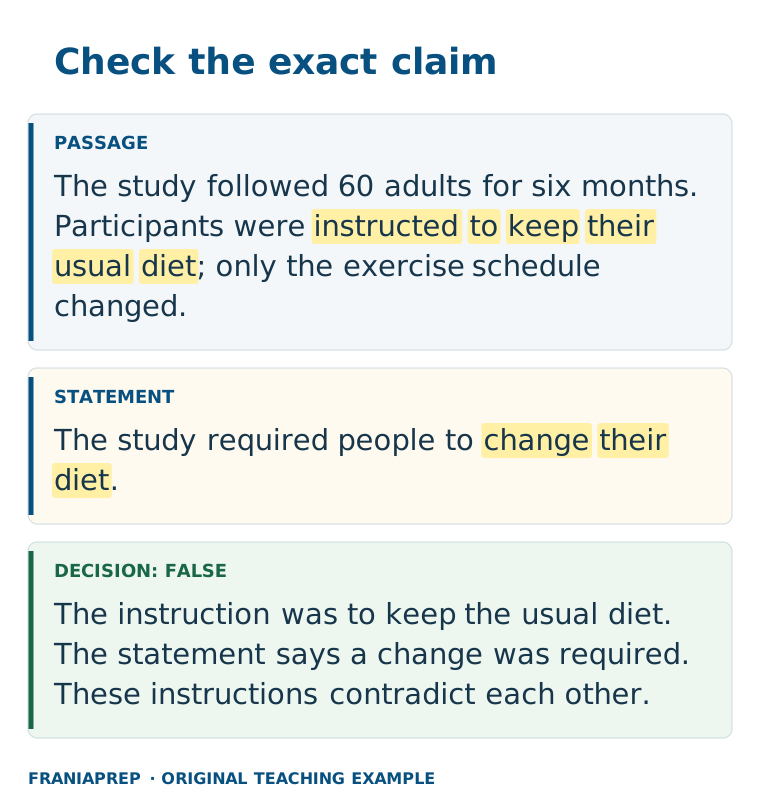
Read the whole statement first: it is about a required change to diet. Next, find the instruction about diet. "Usual diet" means the food people normally ate. They were told to keep that diet. This directly contradicts the statement that a change was required. The answer is False because there is evidence against the claim. This is different from Not Given, where the passage would leave the diet question unanswered.
Put this lesson into practice
Work at your own pace, then check your answers and review the explanations.